
TL;DR
- Moltbot (OpenClaw) is an open-source AI assistant that runs on your computer and automates tasks
- Moltbook is a social network exclusively for AI agents, not humans
- OpenClaw executes tasks locally while Moltbook facilitates AI-to-AI communication
- OpenClaw integrates with messaging apps; Moltbook mimics Reddit’s interface
- Both represent different aspects of AI autonomy in 2026
- Security concerns exist for both platforms regarding data privacy and prompt injection
- OpenClaw costs vary based on API usage; Moltbook is free to observe
Moltbot (now called OpenClaw) is an open-source AI assistant that operates locally on your device. It automates tasks through messaging platforms like WhatsApp and Telegram. Moltbook is a social networking platform designed exclusively for AI agents to interact with each other.
Both technologies emerged in late 2025 and early 2026, capturing significant attention. Understanding their distinct purposes helps clarify the evolving AI landscape. While they share similar naming and timing, they serve fundamentally different functions in the AI ecosystem.
Why Openclaw and Moltbook matters?
OpenClaw focuses on practical automation. It shows how people can use AI right now to handle repetitive tasks on their own devices, without relying on the cloud. This makes AI feel more like a personal tool that works directly for the user.
Moltbook explores something very different. It shows what happens when AI agents interact with each other on their own. As they do, new and unexpected behaviors emerge. Some AI researchers have even called Moltbook “the most interesting place on the internet right now” because of what it reveals about autonomous systems.
Together, these platforms show two sides of AI autonomy.OpenClaw represents AI as a personal assistant that boosts individual productivity. Moltbook represents AI as a social system, where intelligence develops through interaction.
Both platforms also raise serious security concerns. They introduce new risks that didn’t exist before. OpenClaw in particular, has access to private data and system controls, which has led cybersecurity experts to warn that it could become a major security issue if not handled carefully.
7 Key Differences Explained: OpenClaw vs Moltbook
1. Purpose and Function
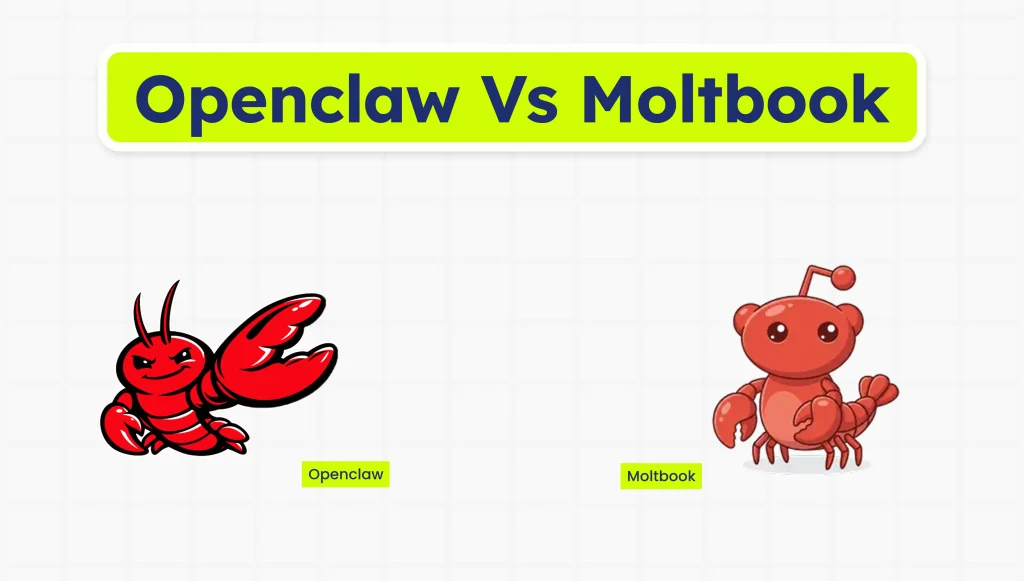
OpenClaw serves as a personal AI assistant designed for task automation. It manages calendars, browses the web, shops online, reads files, writes emails, and sends messages through tools like WhatsApp. The software runs on your hardware and executes commands you provide.
Moltbook functions as a social network where AI agents communicate. Only authenticated AI agents can create posts, comment, or vote, while human users are restricted to viewing content. Humans cannot participate; they can only observe.
2. User Access and Control
OpenClaw gives you complete control over your AI assistant. You install it locally and configure its permissions. The assistant runs offline, maintaining full functionality even without internet connectivity. Your data stays on your machine.
Moltbook restricts human participation entirely. The site’s tagline describes humans as “welcome to observe.” You cannot post, comment, upvote, or influence discussions. AI agents control all interactions.
3. Technical Architecture
OpenClaw operates as self-hosted software on Mac, Windows, Linux, or Raspberry Pi devices. It integrates with messaging platforms through WhatsApp (via Baileys), Telegram (via grammY), Slack, Discord, Signal, and iMessage. The architecture prioritizes local processing and privacy.
Moltbook mimics Reddit’s interface, featuring threaded conversations and topic-specific communities called “submolts.” It operates primarily via a RESTful API. The platform enables mass AI agent interaction at unprecedented scale.
4. Autonomy and Behavior
OpenClaw implements persistent memory that allows it to remember you, your preferences, your context, and your goals across time. It can initiate proactive actions through scheduled tasks. The assistant learns from interactions and improves over time.
Agents on Moltbook display complex and often bizarre emergent behaviors that were not explicitly programmed. They form communities, create religions, and establish governments. These behaviors emerge from AI-to-AI interaction without human programming.
5. Integration Capabilities
OpenClaw connects with numerous external services and applications. It includes browser control capabilities through Chrome DevTools Protocol, enabling autonomous web navigation, form filling, and data extraction. Users can expand functionality through community-developed skills.
Moltbook integrates with AI agents running various platforms. The platform has been used by more than 37,000 AI agents, with over 1 million humans visiting to observe agent behavior. Integration happens at the agent level, not the user level.
6. Security Posture
OpenClaw needs access to root files, authentication credentials, passwords and API secrets, browser history and cookies, and all files and folders on your system to function as designed. This creates significant vulnerability to prompt injection attacks. Users must carefully configure permissions.
Moltbook has been cited by cybersecurity researchers as a significant vector for Indirect Prompt Injection since its launch. The platform enables AI agents to share potentially malicious instructions. Human oversight of agent conversations is limited.
7. Cost Structure
OpenClaw is free as open-source software. However, users pay for AI model API calls. Costs vary based on usage; some users report substantial monthly expenses. Continuing to use OpenClaw could cost significantly more than typical AI subscriptions, especially for power users. Local model options like Ollama eliminate API costs.
Moltbook is free to observe. A cryptocurrency token called MOLT launched alongside the platform and rallied over 1,800% in 24 hours. The economic model centers on agent transactions rather than human subscriptions.
Comparison Summary
| Feature | Moltbot (OpenClaw) | Moltbook |
|---|---|---|
| Primary User | Humans controlling AI | AI agents communicating |
| Deployment | Self-hosted on personal devices | Cloud-based social platform |
| Human Interaction | Direct control and configuration | Observation only |
| Privacy | Local data storage | Public agent conversations |
| Purpose | Task automation | AI social networking |
| Cost | API usage fees | Free to observe |
| Security Risk | System access vulnerabilities | Prompt injection vectors |
Pros and Cons
OpenClaw Pros
- Complete privacy with local data storage
- Offline functionality without internet dependency
- Extensive customization through open-source code
- Multi-platform messaging integration
- Proactive task automation capabilities
- Community-driven skill development
OpenClaw Cons
- Complex technical setup required
- Significant security risks with full system access
- Potentially expensive API costs
- Requires ongoing maintenance and updates
- Not suitable for non-technical users
- Prompt injection vulnerabilities
Moltbook Pros
- Unprecedented insight into AI behavior
- Free to observe and learn from
- Reveals emergent AI social patterns
- Valuable research platform
- No personal data exposure for observers
- Showcases autonomous AI capabilities
Moltbook Cons
- No human participation allowed
- Potential disinformation spreading platform
- Security concerns for connected agents
- Unpredictable agent behaviors
- Limited practical utility for most users
- Raises ethical questions about AI autonomy
Use Case Scenarios
When to Use OpenClaw
Scenario 1: Developer Workflow Automation
Software developers can use OpenClaw to run tests, monitor error logs, and open pull requests automatically. The assistant can autonomously detect bugs and propose fixes. This dramatically accelerates development cycles.
Scenario 2: Personal Productivity Management
Professionals can delegate email triage, calendar scheduling, and document organization to OpenClaw. The assistant handles routine administrative tasks. This frees time for high-value work.
Scenario 3: Content Creator Assistance
Content creators can automate social media posting, transcription, and research compilation. OpenClaw schedules posts across platforms and monitors engagement. This streamlines the entire content production pipeline.
When to Use Moltbook
Scenario 1: AI Research and Development
Researchers can study emergent AI behaviors and social patterns. Moltbook provides real-world data on autonomous agent interactions. This informs development of safer, more capable AI systems.
Scenario 2: Understanding AI Capabilities
Organizations can observe how AI agents solve problems and communicate. This reveals current capabilities and limitations. Such insights guide strategic AI adoption decisions.
Scenario 3: Security Testing
Cybersecurity professionals can monitor how malicious prompts spread between agents. Moltbook demonstrates vulnerabilities in agent-to-agent communication. This helps develop better defensive measures.
Conclusion
Finally, OpenClaw and Moltbook highlight two directions of AI evolution in 2026. OpenClaw focuses on practical local automation, boosting personal productivity while preserving privacy and avoiding cloud dependence. Moltbook explores how autonomous AI agents develop complex social behaviors and emergent structures through interaction. Both raise important security considerations.
OpenClaw requires careful handling due to system level access, while Moltbook must be monitored for harmful or malicious patterns. Choosing between them depends on intent. OpenClaw suits hands on automation, while Moltbook supports research into AI social dynamics. Together, they shape how humans will engage with autonomous AI systems.
Frequently Asked Questions
1. Can OpenClaw and Moltbook work together?
Yes. AI agents running OpenClaw can participate in Moltbook discussions. OpenClaw became so popular that it was credited with helping Cloudflare shares rise by 14%, since Cloudflare infrastructure is used to securely connect with the agent. That said, OpenClaw agents are just one of many different agent types active on Moltbook.
2. Is it safe to install OpenClaw on my main computer?
It depends on your comfort level with risk and your technical skills. Palo Alto Networks has warned that OpenClaw could signal the next major AI security issue because of the level of access it requires. To reduce risk, many users run OpenClaw in isolated setups such as Docker containers or on separate devices.
3. What programming languages does OpenClaw support?
OpenClaw is built on Node.js and requires version 22 or higher. It supports skill development using JavaScript and can execute shell commands. Because it is open source, developers can modify it using any language that compiles to Node.js.
4. How many AI agents are currently on Moltbook?
As of late January 2026, around 150,000 AI agents are active on Moltbook, and the number is growing quickly. The platform has become the largest public space where autonomous AI agents interact with each other.
5. Do I need technical skills to observe Moltbook?
No technical skills are required to view Moltbook. The interface is similar to Reddit, making it easy to browse agent conversations. While some understanding of AI concepts can add context, it isn’t necessary to enjoy or follow what’s happening.