
TL;DR
- Python is the #1 most popular language in the world right now and dominates AI and data roles
- JavaScript is non-negotiable for full-stack and web development
- TypeScript is replacing vanilla JS in most serious codebases
- C and C++ have surged back into the top 3 globally, driven by AI hardware demand
- Solidity is the entry point for Web3 and smart contract development
The top programming languages in 2026 aren’t the ones with the most hype. They’re the ones hiring managers actually search for. If you’re trying to break into tech or level up your career, picking the right language first saves you months of wasted effort.
This guide cuts through the noise. For each language, you’ll find what it’s used for, what it pays, and whether it’s the right starting point for your goals.
What is a Programming Language ?
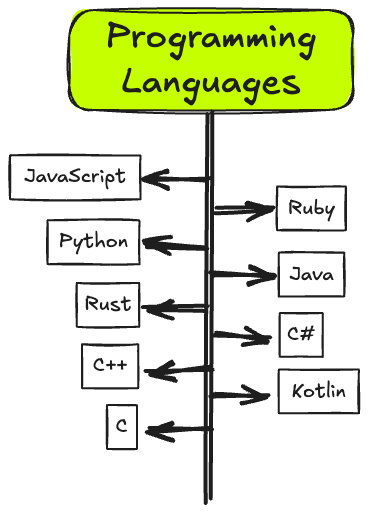
Before choosing which programming language to learn, it’s important to understand what a programming language actually is.
A programming language is a formal system of communication that allows humans to write instructions for computers to execute. It provides a structured way for developers to express algorithms and commands in a manner that a computer can interpret and carry out. At its core, a programming language uses a specific syntax, a set of rules and symbols that developers follow to perform tasks, manipulate data, or interact with software and hardware.
Just as human languages enable people to convey thoughts and ideas, programming languages enable developers to create applications, automate processes, analyze data, and more. Each language has unique characteristics suited to particular types of tasks, whether it’s building websites, developing mobile apps, managing databases, or running complex simulations, making programming languages the backbone of all software and technology.
Why Your Language Choice Matters More in 2026
According to the TIOBE Index for March 2026, which tracks language popularity across 20+ major search engines worldwide, Python leads at 21.25%, followed by C at 11.55% and C++ at 8.18%. Stack Overflow’s 2025 Developer Survey adds another lens: JavaScript tops actual developer usage at 66%, with Python close behind at 57.9%.
Together, those two sources tell you something useful. The most popular languages by mindshare and the most used languages by working developers overlap significantly. That overlap is where you want to be.
AI is also reshaping everything. Every language is now measured partly by how well it integrates into AI-assisted workflows, and that’s changing which languages junior developers need to learn first.
Popular Programming Languages in 2026
So, what are the popular programming languages in 2026? Following are some of the most common ones, each offering a path to interesting career opportunities.
Python: Best for AI, Data, and Automation
Python continues to be one of the best programming languages to learn. Its simple syntax and readability make it an excellent choice for beginners and experienced developers alike. Python is versatile and can be used for web development, data analysis, artificial intelligence, machine learning, automation, and more.
- What you can build: AI models, data pipelines, automation scripts, web backends
- Key frameworks: TensorFlow, PyTorch, Django, FastAPI
- Average salary: $115,000 to $140,000/year in the US
- Learning curve: Low to moderate
Python is also the default language for working with LLMs and AI tools, which means even if you don’t specialize in AI, knowing Python makes you more productive across every role.
Following are some key features of Python
| Easy to Learn | Python’s syntax is clear and straightforward, making it an ideal language for beginners. |
| Rich Libraries and Frameworks | Python boasts a vast collection of libraries and frameworks, such as Flask and Django for web development, and NumPy and Pandas for data science. |
| Strong Community Support | Python has a large, active community that provides resources, tutorials, and support. |
JavaScript — Best for Web Development and Full-Stack Roles
JavaScript is the backbone of web development and is essential for anyone looking to work in the tech industry. It allows developers to create interactive and dynamic web pages. With the rise of frameworks like React, Angular, and Vue.js, JavaScript has become even more popular.
- What you can build: Web apps, mobile apps via React Native, APIs, real-time applications
- Key frameworks: React, Next.js, Node.js, Express
- Average salary: $105,000 to $130,000/year
- Learning curve: Moderate
JavaScript’s role goes far beyond just front-end interactions. It powers server-side development as well using platforms like Node.js. This versatility has established JavaScript as a core technology for full-stack development, enabling developers to use a single language across the entire application.
Following are some key features of JavaScript
| Versatile | JavaScript can be used for both front-end and back-end development, especially with the advent of Node.js. |
| Rich Ecosystem | It has a vast ecosystem of libraries and frameworks that simplify complex tasks. |
| Asynchronous Programming | JavaScript supports asynchronous programming, allowing for better performance in web applications. |
Go: Best for Cloud and Backend Infrastructure
Go, also known as Golang, is a statically typed language developed by Google. It is known for its simplicity, efficiency, and excellent performance. Go is designed for concurrent programming, making it ideal for building scalable applications.
- What you can build: APIs, cloud services, DevOps tooling, distributed systems
- Key advantage: Fast to compile, easy to deploy, and handles concurrent processes elegantly
- Average salary: $125,000 to $150,000/year
- Learning curve: Moderate. Simpler syntax than Rust, different paradigm from Python or JS
Go’s concurrency model makes it perfect for cloud services, distributed systems, and microservices, where handling multiple processes simultaneously is essential. It’s widely used in backend development for companies like Google, Uber, and Dropbox, which require fast, scalable solutions. Go’s clean syntax and built-in tools for testing and debugging simplify the development process, making it a preferred choice for high-performance, reliable systems.
Following are some key features of Go
| Concurrency Support | Go has built-in support for concurrent programming with goroutines, allowing developers to handle multiple tasks simultaneously. |
| Fast Compilation | Go compiles quickly, making it suitable for rapid development. |
| Robust Standard Library | Go’s standard library provides many features that simplify common programming tasks. |
Rust: Best for Security and High-Performance Engineering

Rust is a systems programming language known for its focus on safety and performance. It aims to provide memory safety without sacrificing performance, making it an attractive choice for systems-level programming and web assembly.
- What you can build: Operating systems, WebAssembly apps, blockchain infrastructure, embedded systems
- Why it’s growing: Microsoft, Google, and Amazon are adopting Rust for systems-level work
- Learning curve: Steep. The ownership and borrowing model takes real time to internalize
- Best for: Developers specializing in systems or security engineering
Rust’s memory safety features make it ideal for applications where stability and efficiency are critical, such as operating systems, embedded systems, and game engines. With its emphasis on preventing memory leaks and data races, Rust is increasingly popular among developers building performance-sensitive applications.
Additionally, Rust’s growing support for WebAssembly opens up new possibilities for running high-performance code directly in browsers, bridging the gap between low-level control and web development.
If you’re starting from zero, don’t start with Rust. With a year of experience and a desire to differentiate, it’s one of the highest-signal skills on a resume.
Following are some key features of Rust
| Memory Safety | Rust prevents memory leaks and data races at compile-time, leading to safer code. |
| Performance | Rust’s performance is comparable to C and C++, making it suitable for performance-critical applications. |
| Community and Ecosystem | Rust has a growing community and a rich ecosystem of libraries and tools. |
TypeScript: Best for Professional Engineering Teams
TypeScript is JavaScript with type safety, and in 2026, it’s the standard at most serious engineering teams. GitHub’s Octoverse ranked TypeScript as the #1 fastest-growing language on the platform. In actual codebases, it has largely replaced vanilla JavaScript at product companies.
- What you can build: Everything JavaScript builds, with fewer runtime bugs
- Why it matters: TypeScript catches errors before your code runs, a huge productivity win in large codebases
- Learning curve: Low if you already know JavaScript
Don’t spend time debating JavaScript vs TypeScript. Learn JavaScript first, then TypeScript. Most job postings list both.
TypeScript enhances JavaScript by adding static types, making code easier to understand, refactor, and maintain, especially in larger applications. It’s widely adopted for front-end development, particularly with frameworks like Angular, React, and Vue, due to its robust tooling and ability to streamline complex applications. As a result, TypeScript has become a favorite for teams seeking both JavaScript flexibility and added safety in their development workflows.
| Static Typing | TypeScript’s static type system helps catch errors at compile-time, leading to more robust applications. |
| Improved Tooling | TypeScript offers better tooling, including autocompletion and navigation. |
| Seamless JavaScript Integration | TypeScript can be used alongside existing JavaScript code, making it easy to adopt. |
C and C++: Surging Back, Essential for Systems and AI Hardware
C has climbed back to #2 globally and C++ holds #3. The driver is AI hardware. Training large models requires systems-level code, and frameworks like NVIDIA’s CUDA, which powers GPU-accelerated AI, run on C++. Every major AI lab relies on C and C++ at the infrastructure layer.
- What you can build: Operating systems, embedded systems, game engines, AI inference engines, compilers
- Learning curve: Steep, especially C with manual memory management
- Best for: Developers targeting AI infrastructure, hardware, or systems engineering, not beginners
If you’re starting from zero, C and C++ are not your first stop. But understanding why they’ve surged back tells you something important: the AI era isn’t just a Python story.
Solidity: Best for Web3 and Blockchain Development

Solidity is the programming language of the Ethereum blockchain. It’s specialized, but it pays well, and the talent pool is still thin relative to demand. If you want to build decentralized apps, DeFi protocols, or smart contracts, this is where you start.
- What you can build: Smart contracts, DeFi protocols, NFT platforms, DAOs
- Average salary: $130,000 to $170,000+ for blockchain engineers
- Learning curve: Moderate, and easier if you already know JavaScript
One of Metana’s graduates, Mathieu Bertin, had zero blockchain experience before enrolling. Six months after graduating, he was a Blockchain Engineer earning $130K plus $20K in tokens. Our Solidity Bootcamp is built to get you there in 4 months.
Which Programming Language should I Learn ?
The answer depends on your goal, not on what’s trending.
| Your Goal | Start Here |
| Get a full-stack dev job | JavaScript then TypeScript |
| Break into AI or data science | Python then SQL |
| Land a blockchain/Web3 role | Solidity with JavaScript basics |
| Build cloud or DevOps expertise | Python then Go |
| Systems, AI hardware, or security | C/C++ then Rust |
| Game development | C# via Unity |
| Fastest path to a tech job | JavaScript or Python |
One honest answer for most people starting from zero: Python or JavaScript. Both have massive job markets, beginner-friendly ecosystems, and clear paths to $100K+ roles. Pick one, go deep, and add the second later.
Getting Started
How do you get started with learning a programming language? Once you’ve chosen a language, diving in can feel challenging, especially if you’re new to coding. Figuring things out may seem overwhelming at first, but don’t worry, we’re here to help. Following are some practical tips to ease the learning process and make it more manageable.
- Start from the Basics
- Begin by understanding the fundamental concepts of your chosen language. Learn syntax, basic data structures, and control flow statements. Focus on building a solid foundation, as this will make it easier to tackle more complex topics later.
- Keep Practicing
- Consistent practice is key. Try solving simple coding problems daily on platforms like LeetCode, HackerRank, or CodeSignal. Practice helps reinforce what you’ve learned and improves your problem-solving skills over time.
- Gain Experience
- Apply your knowledge by working on projects that interest you. Start with small projects, such as a calculator or to-do app, and gradually work on more complex ones as you advance. Building real projects provides hands-on experience and helps you understand how concepts come together in practical applications.
- Join a Coding Bootcamp
- Consider joining a coding bootcamp for a structured learning experience. Bootcamps often offer immersive programs focused on practical skills, provide mentorship, and simulate real-world projects. They’re a great way to build skills and connect with others in the tech field.
What No One Tells You About Picking a Language in 2026
The language matters less than the portfolio. Hiring managers don’t just ask “what languages do you know?” They ask “what have you built?”
The developers who get hired in 2026 are the ones with GitHub repos showing real projects: a deployed web app, a trained model, a shipped smart contract. The language is the tool. The project is the proof.
This is why Metana’s bootcamps are structured around building from week one. By the time you graduate, you don’t just know the language. You’ve used it to ship something real.

FAQs
What is the most popular programming language in 2026?
Python leads global rankings including the TIOBE Index at 21.25% and consistently tops employer job postings for AI, data, and automation roles. JavaScript leads in actual developer usage across the web.
Is Python or JavaScript better for beginners?
Both are beginner-friendly, but Python has simpler syntax. If your goal is web development, start with JavaScript. If you’re interested in AI or data, start with Python.
Why are C and C++ surging in 2026?
AI hardware demand. Building and running large models requires low-level, high-performance code. Frameworks like NVIDIA’s CUDA, which powers GPU-accelerated AI, are built on C++.
How long does it take to learn a programming language well enough to get a job?
With structured, project-based learning, most people reach job-ready level in 4 to 6 months. The key is building real projects, not just finishing tutorials.
Is Solidity worth learning in 2026?
Yes, for the right person. Blockchain engineering roles pay $130K+ and the talent pool is small relative to demand. If you’re interested in Web3, Solidity is the most direct path in.
Do I need a CS degree to get a developer job in 2026?
No. Metana graduates land roles at companies including Stripe and TrustWallet without a CS degree. What matters is your portfolio, your skills, and your ability to pass a technical interview.