

- Full stack development covers both front-end and back-end of a web application
- Full stack developers work with UI, servers, databases, and APIs end to end
- The role requires understanding architecture, security, scalability, and performance
- In 2026, full stack developers are highly in demand with strong global salary potential
- AI supports development, but end-to-end system knowledge keeps full stack developers essential
Imagine you’re running a slick online sneaker store. Hype drops, sold-out alerts, customers rushing in.
But then—bam. The site crashes. Payments fail. Orders vanish. Your inbox? A mess.
That’s not just a bad day. That’s a broken system. This is where full stack development comes in. We at metana.io will walk you through how it all comes together!
What is full stack development?
Full stack development is the whole process involved in building and running both the front-end and back-end of a website or web application. In simple terms, it means taking care of everything, from what the user sees on the screen, like buttons and layouts, to what happens in the background, like server logic, database operations, and API calls. After all, full stack development manages every layer of how a web application functions and performs.
What is a full stack developer?
A full stack developer is proficient in handling all layers of a web application, from designing user interfaces to managing databases. This versatility makes them invaluable in the industry, as they can handle a wide range of tasks, from web development to deployment.
Key areas of expertise for full stack developers include:
- Front-End Development: Building user interfaces with technologies like HTML, CSS, and JavaScript, often using frameworks like React, Angular, or Vue.js.
- Back-End Development: Managing server-side logic using languages and frameworks such as Node.js, Python (Django/Flask), Ruby on Rails, or PHP.
- Database Management: Working with SQL (MySQL, PostgreSQL) or NoSQL (MongoDB, Firebase) databases to store and retrieve application data.
- API Integration: Creating and consuming RESTful or GraphQL APIs for communication between client and server.
How much does a full stack developer typically earns?
As of January 5, 2026, the average annual salary for an International Full Stack Developer in the United States is $123,262, according to ZipRecruiter.
That’s approximately $59.26 per hour, or $10,271 per month. Most salaries fall between $102,500 (25th percentile) and $142,000 (75th percentile), with top earners making up to $164,500 per year.
This wide pay range highlights strong opportunities for career growth, higher earnings, and advancement based on skills, experience, and location (Source: Ziprecruiter.com).
Understanding the Three-Tier Architecture in Full Stack Development
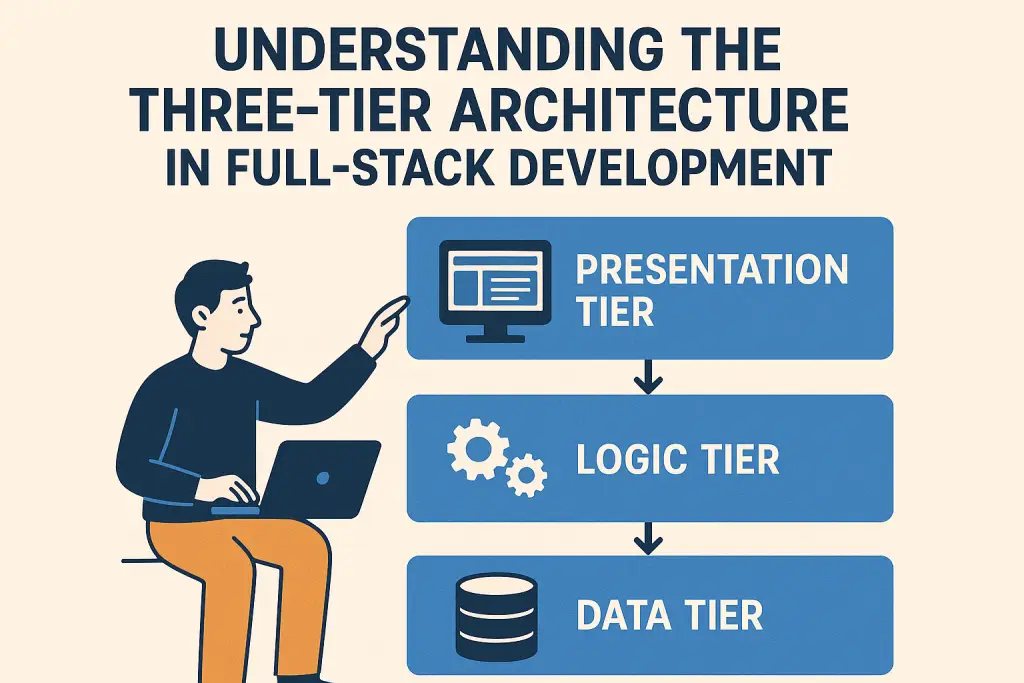
A foundational concept in full stack development is the three-tier architecture model, which separates an application into three layers:
- Presentation Tier: The front-end layer that handles user interaction and displays content.
- Application Tier: The back-end layer responsible for processing logic, requests, and commands.
- Data Tier: The database layer that stores, retrieves, and manages application data.
The Evolution of Web Development
The history of web development since the late 1980s, reflects a journey of rapid innovation and transformation. As the internet has evolved, so have the technologies and techniques used to build modern web applications, shifting from basic static websites to powerful, dynamic platforms.
From Static Web Pages to Interactive Applications
In the early stages of the internet, websites were primarily built using static HTML, offering limited interactivity and functionality. These early web pages were simple, text-based, and lacked real-time responsiveness.
The emergence of server-side scripting (e.g., PHP, ASP) and relational databases enabled developers to create dynamic web applications. This advancement allowed websites to display personalized content, handle form submissions, and support user authentication.
Technologies such as:
- JavaScript – enabling client-side interactivity
- CSS – improving layout and design
- AJAX – allowing asynchronous data loading
…transformed websites into engaging, responsive, and user-friendly experiences.
The Rise of the Full Stack Developer
As web applications became more feature-rich and data-driven, development workflows grew more complex. This gave rise to the full stack developer in 2010s ~a professional capable of handling both front-end (user interface) and back-end (server and database) tasks.
What is the role of full stack developers?
Full stack developers bridge the gap between design and infrastructure by:
- Building intuitive front-end interfaces using frameworks like React or Angular
- Developing scalable back-end systems with Node.js, Python, or Ruby
- Managing databases such as MongoDB or PostgreSQL
- Integrating APIs and third-party services
The ability to oversee the entire development process has made full stack developers essential in modern software teams, particularly in agile, startup, and DevOps environments.
The Front-End Development Landscape
The front-end development landscape is rapidly advancing, driven by continuous innovation in HTML, CSS, and JavaScript. As users increasingly expect seamless, interactive, and mobile-optimized experiences, the demand for skilled front-end developers has surged. These developers are responsible for creating the visual and interactive components of websites, ensuring a smooth and engaging user experience (UX) across all platforms.
HTML, CSS, and JavaScript: The Core of Front-End Development
At the heart of every front-end developer’s toolkit are three foundational technologies:
- HTML (HyperText Markup Language): Provides the structural foundation of a web page. It defines the layout and content through elements such as headings, images, links, and forms.
- CSS (Cascading Style Sheets): Handles the visual styling of the page. CSS allows developers to control fonts, colors, spacing, and create responsive designs that adjust to different screen sizes.
- JavaScript: Adds interactivity to websites. It powers everything from dynamic content updates and animations to form validation and API integration.
Mastery of these three technologies is essential for building responsive, fast-loading, and user-friendly web applications that meet modern web standards.
Why Front-End Development Is Important
In a competitive digital environment, businesses rely heavily on front-end developers to:
- Boost user engagement with intuitive and interactive interfaces
- Ensure responsiveness across devices, particularly mobile phones and tablets
- Improve website performance and SEO rankings through clean, optimized code
- Maintain consistent branding and visual appeal across all user touchpoints
Popular Front-End Frameworks and Libraries
To streamline development and enhance scalability, modern front-end developers use a variety of JavaScript frameworks and libraries:
React, Angular, and Vue.js
- React: Developed by Facebook, React is known for its component-based architecture and high performance in single-page applications.
- Angular: A robust framework by Google, Angular offers a complete solution for building enterprise-grade web apps with TypeScript.
- Vue.js: Lightweight and flexible, Vue is praised for its simplicity and ease of integration, making it ideal for both small projects and large-scale applications.
Each framework caters to different project needs and development preferences, offering unique advantages in terms of performance, learning curve, and ecosystem.
CSS Frameworks and Preprocessors
Beyond JavaScript frameworks, front-end developers also utilize tools to enhance styling efficiency:
- CSS Frameworks: Frameworks like Bootstrap and Foundation provide pre-built UI components and grid systems, allowing for rapid development of responsive layouts.
- CSS Preprocessors: Tools such as Sass and Less extend native CSS with features like variables, mixins, and nesting, enabling more modular and maintainable codebases.
Responsive Design and User Experience (UX)
In today’s mobile-first world, responsive web design is no longer optional—it’s essential. Front-end developers must ensure that applications adapt fluidly to different screen sizes and orientations.
Additionally, UX design focuses on the usability and intuitiveness of a web application. Combining responsive design with UX best practices results in web experiences that not only function well but also delight users.
Mastering Back-End Development
To build robust and scalable web applications, one must have a solid grasp of back-end development principles. Back-end development encompasses the server-side logic, database integration, and API connectivity that power a web application.
Server-Side Programming Languages
Server-side programming languages are the backbone of back-end development. They enable developers to create dynamic content, interact with databases, and implement complex business logic.
1. Node.js, Python, and PHP
Node.js has gained popularity for its non-blocking, event-driven architecture, making it ideal for real-time applications. Python is renowned for its simplicity and versatility, with frameworks like Django and Flask simplifying the development process. PHP remains a staple in web development, powering a significant portion of the world’s websites.
2. Java, C#, and Go (Golang)
Java is a robust choice for large-scale enterprise applications, thanks to its platform independence and vast ecosystem. C# is a modern, object-oriented language developed by Microsoft, widely used for Windows and web application development. Go (Golang) is designed for performance and scalability, making it a popular choice for building high-throughput APIs, microservices, and cloud-native systems where efficiency and concurrency are critical.
3. Back-End Frameworks and Libraries
Back-end frameworks and libraries play a crucial role in streamlining development, providing pre-built components, and enforcing best practices. For instance, Express.js for Node.js simplifies the creation of web applications, while Django for Python provides an architecture, templates, and APIs out of the box.
API Development and RESTful Services
APIs (Application Programming Interfaces) enable different applications to communicate with each other. RESTful APIs, in particular, have become the standard for web services due to their stateless nature and cacheability. Developing RESTful APIs requires understanding HTTP methods, status codes, and resource naming conventions.
As illustrated by a quote:
“APIs are the new UI”
the importance of API development cannot be overstated. A well-designed API is crucial for the success of a web application, allowing for flexibility and scalability.
Database Management for Full Stack Developers
Effective database management is crucial for full stack developers to ensure seamless data interaction between the front-end and back-end of web applications. Database management encompasses a broad range of tasks, including data modeling, database schema design, query optimization, and data security.
1. Databases: MySQL, PostgreSQL
SQL databases, also known as relational databases, are structured around tables with well-defined schemas. MySQL and PostgreSQL are two of the most popular SQL databases used in web development. MySQL is renowned for its ease of use and scalability, making it a favorite among developers for web applications. PostgreSQL, on the other hand, is known for its robustness and ability to handle complex transactions, making it suitable for large-scale enterprise applications.
2. NoSQL Databases: MongoDB, Redis
NoSQL databases offer a flexible schema design or schema-less data models, making them ideal for handling large volumes of unstructured or semi-structured data. MongoDB is a document-oriented NoSQL database that stores data in JSON-like documents, allowing for flexible data modeling. Redis is an in-memory data store that can be used as a database, message broker, or cache layer, known for its high performance and low latency.
3. Database Design and Query Optimization
Effective database design is critical for ensuring data integrity and performance. This involves normalizing data to minimize redundancy and dependency. Query optimization is also essential, as it directly impacts the performance of the application. Techniques such as indexing, caching, and optimizing SQL queries can significantly improve database performance.
To optimize database performance, full stack developers should consider the following best practices:
- Use indexing to speed up query execution.
- Optimize database schema for data normalization.
- Implement caching mechanisms to reduce database load.
- Regularly monitor and analyze query performance.
Essential Tools in the Full Stack Development Ecosystem
The ecosystem of full stack development is rich with tools that enhance productivity and streamline processes. Full stack developers rely on a variety of tools to manage different aspects of their work, from version control to deployment.
1. Version Control with Git and GitHub
Version control is crucial in full stack development, and Git is the most widely used version control system. It allows developers to track changes, collaborate on projects, and manage different versions of their codebase. GitHub complements Git by providing a platform for hosting and sharing repositories, making it easier for developers to collaborate on open-source projects.
2. Development Environments and Code Editors
A good development environment is vital for productivity. Popular code editors like Visual Studio Code and Sublime Text offer a range of features such as syntax highlighting, code completion, and debugging tools. These editors support a wide range of programming languages and are highly customizable.
3. Testing, Debugging, and Performance Tools
Testing and debugging are critical phases of development. Tools like Jenkins for continuous integration, Jest for unit testing, and Chrome DevTools for debugging help ensure that applications are robust and perform well. Performance tools like Google PageSpeed Insights provide insights into how to improve application performance.
4. Containerization with Docker
Docker has revolutionized the way applications are deployed using containerization. It allows developers to package their applications and dependencies into containers that can run consistently across different environments, simplifying deployment and scaling.
| Tool | Purpose | Benefits |
| Git | Version Control | Tracks changes, enables collaboration |
| Visual Studio Code | Code Editor | Syntax highlighting, code completion |
| Docker | Containerization | Consistent deployment, easy scaling |
The Full Stack Development Process
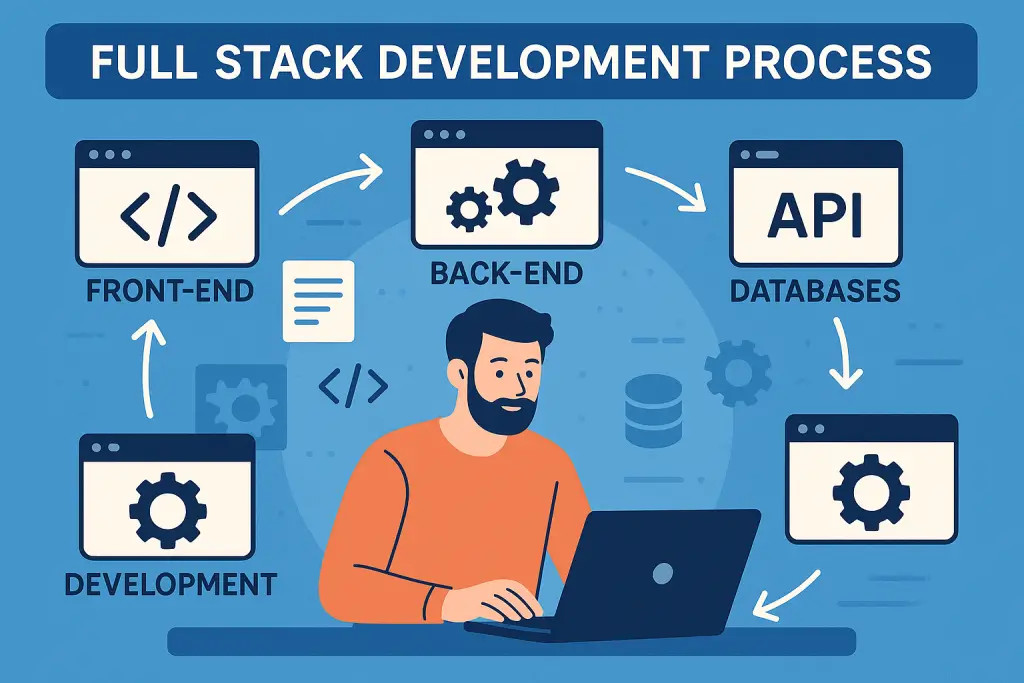
Understanding the full stack development process is crucial for delivering high-quality, scalable applications. This process encompasses several critical phases, from planning and architecture design to deployment and maintenance.
1. Planning and Architecture Design
The initial phase of full stack development involves thorough planning and architecture design. This stage is crucial for defining the project’s scope, identifying potential challenges, and outlining the technical requirements. As Jeff Atwood, Co-Founder of Stack Overflow, once said, “The best code is no code at all“. Effective planning helps minimize the amount of code needed and ensures a smoother development process.
2. Agile Development Workflows
Agile development methodologies have become a staple in full stack development. Agile emphasizes flexibility, collaboration, and rapid iteration. By adopting agile workflows, development teams can respond quickly to changing requirements and deliver functional components of the application in short cycles, known as sprints.
3. Deployment Strategies and DevOps Practices
Deployment strategies and DevOps practices play a vital role in the full stack development process. DevOps fosters a culture of collaboration between development and operations teams, ensuring that the application is not only developed efficiently but also deployed and maintained effectively. Key practices include continuous monitoring, automated testing, and infrastructure as code.
4. Continuous Integration and Continuous Deployment
Continuous Integration (CI) and Continuous Deployment (CD) are essential practices in modern full stack development. CI involves regularly integrating code changes into a central repository, where automated tests are run. CD takes this further by automatically deploying code changes to production after they pass the tests, ensuring that new features and fixes are delivered to users quickly and reliably.
By embracing these practices, full stack development teams can ensure a streamlined process that delivers high-quality applications efficiently.
What do you need to learn to become a fullstack developer?
As the demand for versatile developers grows, building a career in full stack development can be both rewarding and challenging. To succeed, it’s crucial to understand the essential skills and qualifications required for the role.
1. Essential skills and qualifications
A full stack developer should possess a broad range of skills, including proficiency in front-end technologies like HTML, CSS, and JavaScript, as well as back-end technologies such as Node.js, Python, or Ruby. Familiarity with database management systems, version control, and containerization is also vital. Let us summarize it easily for you:
| Category | Skills & Tools |
| Front-End Development | HTML, CSS, JavaScript, React, Angular |
| Back-End Development | Node.js, Python, Ruby, Express, Django |
| Database Management | MySQL, MongoDB, Data Modeling |
| Version Control | Git, GitHub |
| Containerization | Docker |
2. Building a Portfolio and GitHub Presence
Creating a strong portfolio and maintaining an active GitHub presence are critical steps in demonstrating your capabilities to potential employers. Showcase your projects, contribute to open-source initiatives, and engage with the developer community to build your professional network.
3. Job Opportunities and Salary Expectations in the US
Considering the full stack developers job market, it offers numerous opportunities, with competitive salaries for full stack developers ranging from $70,000 to over $150,000 depending on experience, location, and industry.
| Job Title | What It Means |
| Junior Full Stack Developer | An entry-level role focused on learning the basics of front-end and back-end development while contributing to smaller features under supervision. |
| Full Stack Developer | A standard mid-level role responsible for building and maintaining complete web applications across the stack. |
| Senior Full Stack Developer | Takes ownership of complex projects, mentors junior developers, and contributes to architecture and performance improvements. |
| Full Stack Engineer | A more engineering-heavy role that includes deep understanding of system design, scalability, and performance optimization. |
| Front-End Focused Full Stack Dev | Primarily works on user interface and experience but contributes to back-end tasks when needed. |
| Back-End Focused Full Stack Dev | Specializes in server-side logic, databases, and APIs, but can also handle front-end components. |
| DevOps-Enabled Full Stack Dev | Combines full stack skills with deployment, CI/CD, and infrastructure automation expertise. |
| Technical Lead / Engineering Lead | Oversees technical direction, mentors team members, and ensures best practices are followed across the codebase. |
| Solutions Architect | Designs end-to-end software solutions, often working closely with stakeholders and development teams. |
| CTO (Chief Technology Officer) | In startup environments, experienced full stack developers often rise to CTO positions, managing the entire tech vision and product delivery. |
4. Freelancing vs. Full-Time Employment
Full stack developers can choose between freelancing and full-time employment. Freelancing offers flexibility and autonomy, while full-time employment provides stability and benefits. Consider your personal preferences, career goals, and financial needs when deciding which path is right for you.
Can I Become a Full-Stack Developer Without a Degree?
Yes, you can absolutely become a full-stack developer without a traditional college degree. In today’s tech industry, skills often matter more than formal education. Many successful developers like Chris Wanstrath (Co-founder and former CEO of GitHub) are self-taught, have dropped out of University or have completed alternative learning paths, for example; coding bootcamps.
These intensive programs are designed to equip you with practical, job-ready skills in a short period (6- 24 months) and and they make a solid impression on your resume! Metana is one such bootcamp listed by Forbes helping aspiring developers break into tech with hands-on training and real-world projects!
Common Challenges and Best Practices in 2026
Full stack development continues to present challenges, from maintaining strong security and optimizing performance to keeping pace with rapidly evolving technologies. In 2026, developers must adopt modern best practices to build secure, scalable, and high-performing applications in cloud-first and AI-assisted environments.
1. Security Considerations
Security remains a top priority for full stack developers. Common threats such as SQL injection, cross-site scripting (XSS), and insecure APIs can compromise applications if not properly handled. To reduce risk, developers should follow secure coding standards, validate all user input, and store credentials using modern hashing and salting techniques. In 2026, practices like zero-trust security, dependency vulnerability scanning, and regular penetration testing are essential for protecting applications.
| Security Measure | Description | Benefits |
| Input Validation | Checking user input for malicious content | Prevents SQL injection and XSS attacks |
| Secure Password Storage | Using hashing and salting to protect passwords | Protects user credentials |
2. Performance Optimization
Optimizing application performance is critical for user satisfaction. Techniques such as caching, minifying and compressing assets, and optimizing database queries can significantly improve application speed. Developers should also leverage tools like Google PageSpeed Insights to identify areas for improvement. Application performance directly impacts user experience and retention.
3. Staying Updated with Evolving Technologies
The full stack ecosystem continues to evolve rapidly with advancements in cloud computing, AI-assisted development, and new frameworks. To stay competitive, developers must engage in continuous learning through documentation, online communities, conferences, and hands-on experimentation. Staying current ensures applications remain secure, maintainable, and aligned with industry standards.
Will AI replace full-stack developers?
Short answer: Not anytime soon.
While AI tools like, Claude, Gemini, GitHub Copilot, ChatGPT, and low code platforms are transforming how developers work, they are not a replacement for full stack developers, at least not in the way many people imagine.
In 2026, the conversation won’t be “Should we use AI?”
Matt Middlestetter, Managing Partner, Tactics Marketing
It will be: “How do we use it and make sure our data remains private and secure?”
And confidential AI is the technology that answers that question.
Why AI Cannot Fully Replace Full Stack Developers Yet
AI lacks human level problem solving.
Full stack developers do not just write code. They design systems, make architectural decisions, and think critically about performance, scalability, security, and user experience. AI can assist, but it does not understand business context or trade offs the way humans do.
Creativity and intuition still matter.
Building real products involves UX decisions, feature prioritization, and collaboration across teams. These judgment based skills are deeply human and cannot be reliably automated.
Code is only part of the job.
Full stack roles include debugging, reviewing code, setting up environments, deploying applications, working with stakeholders, and mentoring others. AI can support these tasks, but it does not manage them end to end.
AI still needs supervision.
AI generated code must be reviewed, tested, and secured. Without human oversight, it can introduce bugs, performance issues, or security vulnerabilities.
The Reality: AI Assisted Full Stack Developers
Rather than replacing developers, AI is becoming a powerful productivity multiplier. It automates repetitive work, suggests improvements, and accelerates development. In 2026 and beyond, the most successful professionals will be full stack developers who know how to work effectively with AI, not those who try to compete against it.
Finally
Full stack development is evolving faster than ever, driven by AI, machine learning, and connected systems. The developers who win in this new era are not the ones who know a single tool, but those who understand how systems work end to end, adapt quickly, and keep learning as the industry changes.
If you want to build real products, work on global teams, and compete for high paying international roles, now is the time to invest in the right skills.
Start your journey with Metana Full Stack Software Engineering Bootcamp. Learn the skills that matter, build job ready projects, and prepare for a future where opportunity is global. Apply now and take control of your tech career.
Frequently Asked Questions
1. What is the difference between front-end and back-end development?
Front-end development focuses on creating the user interface and user experience of a website or application using HTML, CSS, and JavaScript, while back-end development involves server-side programming, database management, and API integration.
2. Can I learn full-stack development in 3 months?
While you can grasp the basics in 3 months with focused effort, becoming job-ready typically takes 6–12 months of consistent practice.
3. Is full stack development still in demand?
Yes. In 2026, full stack development remains more valuable than ever, especially for startups and fast-growing companies that need developers who can work across the entire product stack. Versatility, system-level thinking, and speed of execution continue to make full stack developers highly sought after.
4. Are full stack developers highly paid?
Yes. Full stack developers continue to earn strong, competitive salaries in 2026. Internationally, a full stack developer earns an average annual salary of around $120,000+, with entry-level roles starting near $50,000 and senior roles reaching $170,000+. On an hourly basis, full stack developers can earn approximately $24 to $85 per hour, depending on several factors:
- Region
- Years of experience
- Tech stack and specialization
- Company size and industry
5. Can Full Stack Development Include Mobile App Development?
- While focused on web applications, skills can extend to mobile app development.
- Knowledge in cross-platform frameworks like React Native is beneficial.
6. What is the Difference Between a Full Stack Developer and a DevOps Engineer?
- Full stack developer: Builds and maintains web applications.
- DevOps engineer: Focuses on software development processes and IT operations integration.